How to Help Your Child Learn to Sing – Even If You Can’t Carry a Tune
The best microphone in my childhood home was a skipping rope handle.
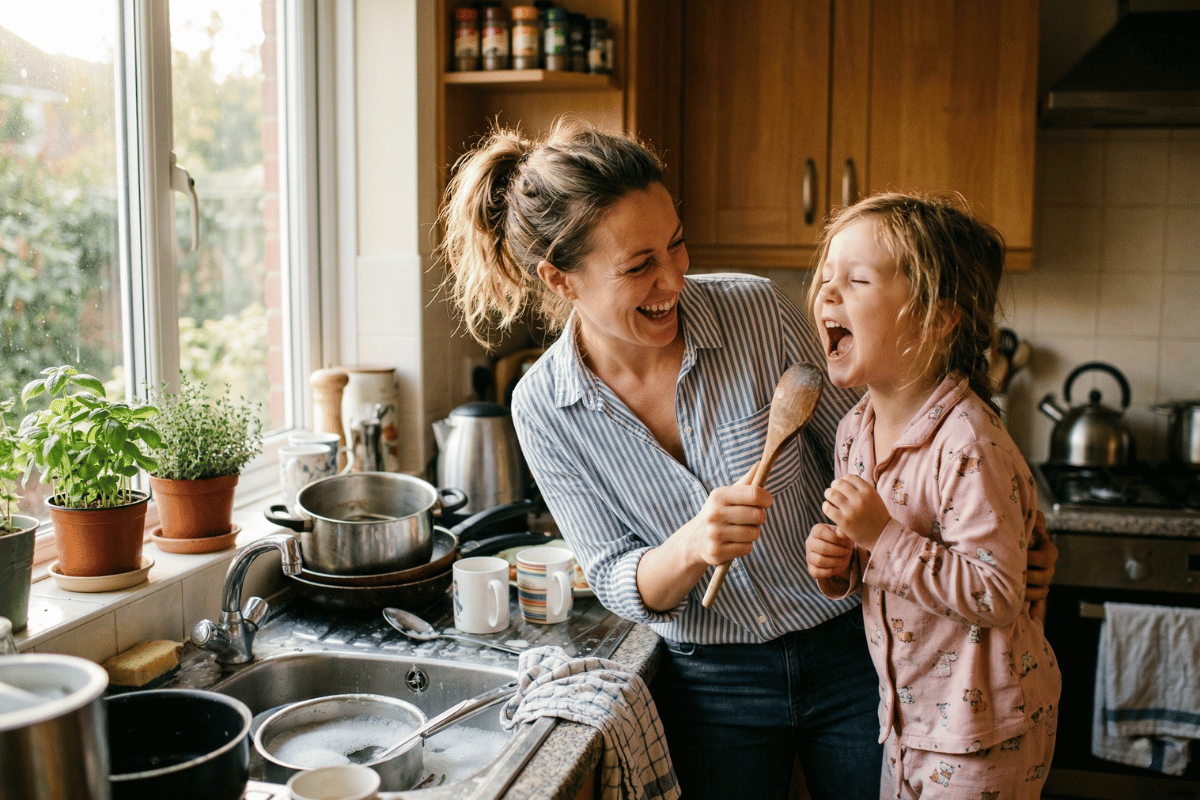
I would drag it out of the hall cupboard, stand in front of whoever was willing to watch, and sing. My mom would clap, sing along in her own way — not perfect and completely unbothered by it — and tell me I sounded wonderful. She had no musical training. She wasn’t a singer. But she sang anyway.
I went on to study at music conservatory, earn a Master’s of Music, perform as a professional opera singer, and spend over a decade teaching other people’s children to find their voices. I’ve thought a lot about what set that path in motion. I keep coming back to her — to the skipping rope handle, to someone who had no credentials singing freely in the kitchen without a second thought.
If you’re a non-musical parent whose child loves singing, this is for you.
Table of Contents
Can I Really Help My Child Sing If I Can’t Sing Myself?
Yes — and you’re probably better positioned than you think. The most common mistake non-musical parents make isn’t technical. They don’t accidentally teach the wrong breathing technique or choose the wrong songs. What they do is go quiet. They step back, assuming their lack of musical knowledge will do damage somehow — when the opposite is usually true.
Your presence, your engagement, your willingness to make sound: these matter far more than your pitch accuracy.
Why Your Imperfect Voice Is Not the Problem
Here’s something most singing guides won’t say plainly: your child doesn’t need a perfect voice to model from. They need a singing parent. There’s a real difference between the two.
When a parent sings in front of their child — badly, happily, without apology — they’re teaching something no professional recording can teach. They’re showing that singing is just something people do. That it doesn’t require permission, or training, or a particular quality of voice. That the point is the feeling, not the grade.
A child who grows up hearing their parent sing freely tends to be relaxed about their own voice. They experiment. They take risks. They’re not waiting to be “good enough” before they join in.
Compare that to a child who only ever hears polished, perfect singing — from playlists, from performances, from digitally produced tracks. Somewhere, quietly, they absorb a message: singing is a performance standard. My voice, measured against that, probably falls short.
The parent who sings off-key in the car is doing something quietly radical. They’re giving their child permission.
🗣️ Say this if you feel self-conscious about your own voice: “I’m not the greatest singer, but I love it anyway. Want to sing with me?” That sentence alone is worth more than a term of lessons.
One Thing Worth Knowing If Pitch Is a Real Struggle
Now, a nuance — and I want to say this carefully, because I don’t want it to become a reason not to sing.
If pitch is genuinely difficult for you — not just slightly off, but significantly different melodies from the ones your child is learning — it’s worth making sure they’re also regularly hearing music the way it’s meant to sound. Not instead of singing with you. Alongside it.
Children develop their musical ear primarily through listening, especially in the early years. A young ear forms around what it hears most — which is both the reason this matters and the reason it’s fixable.
You don’t need to take them to concerts every week (though they’ll remember those forever). A playlist in the kitchen. A favourite film with a good soundtrack. A CD in the car alongside your singing.
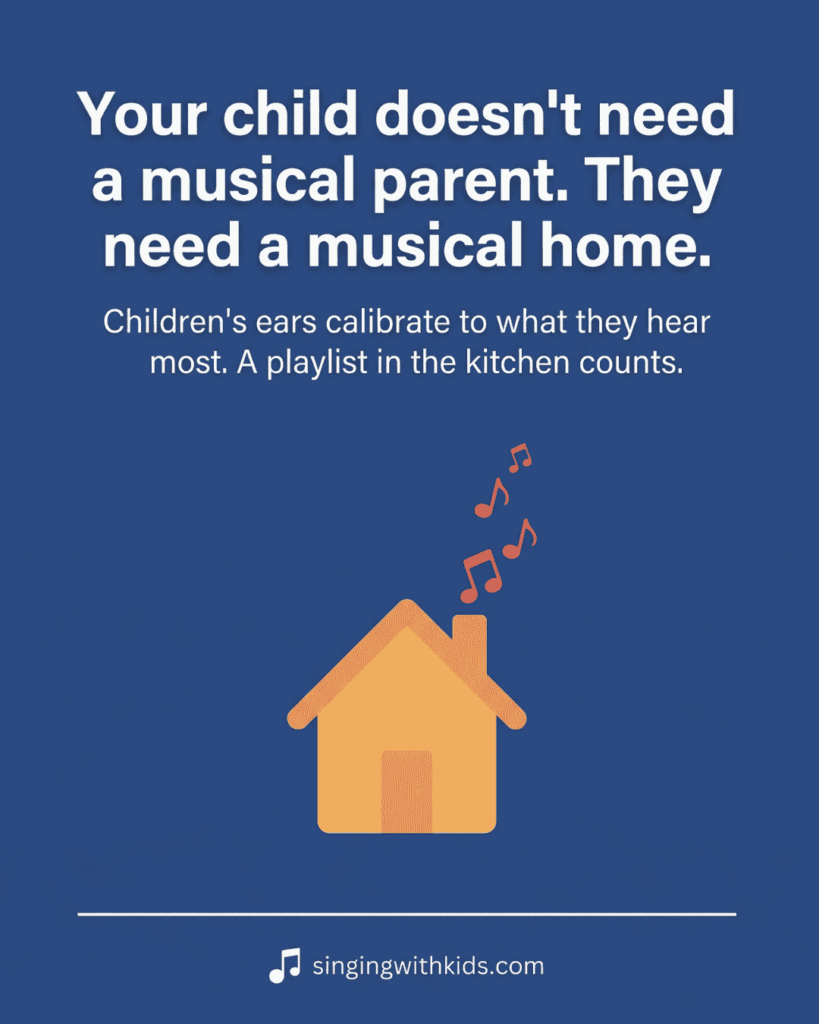
Shinichi Suzuki, whose teaching method shaped music education across the world, understood this deeply. He worked with children whose ears had simply calibrated around whatever they heard most — including music sung incorrectly. His approach was straightforward: surround those children with the correct version of the same music, repeatedly, until the new pattern gradually replaced the old one. It worked. The ear learns what it hears most. Which means what plays in your home matters — in the best possible way.
The message is simple: sing with your child freely. And make sure beautiful music is always somewhere in the background of their days.
🗣️ Say this when putting music on: “Let’s listen to how this singer does it — can you hear how they breathe at the end of that long note?” You don’t have to know the answer. The listening habit is what matters.
What Supporting Your Child’s Singing Actually Looks Like
It’s simpler than most parents expect.
Sing in the everyday moments
The car. The bath. Cooking dinner. Getting ready for school. These aren’t practice sessions — they’re just life that includes sound. For younger children especially (roughly 2–7), this is where the love of singing is built or quietly discouraged. A parent who sings while making toast is more influential than one who drives their child to weekly lessons but stays silent at home.
For older children (8 and up), this might look different: a shared playlist, singing along to a favourite song together, asking them to teach you something they’ve learned. They’re becoming more self-conscious at this age, and they’ll take cues from you about whether singing is something cool or something embarrassing.
Don’t correct. Notice.
There’s a difference between a parent who is enjoying their child’s singing and one who is assessing it. Children feel that difference, even when the assessment is positive. “That was great!” said with an evaluating ear is not the same as laughing, clapping, asking for an encore because you genuinely enjoyed it. The first creates self-consciousness. The second creates confidence.
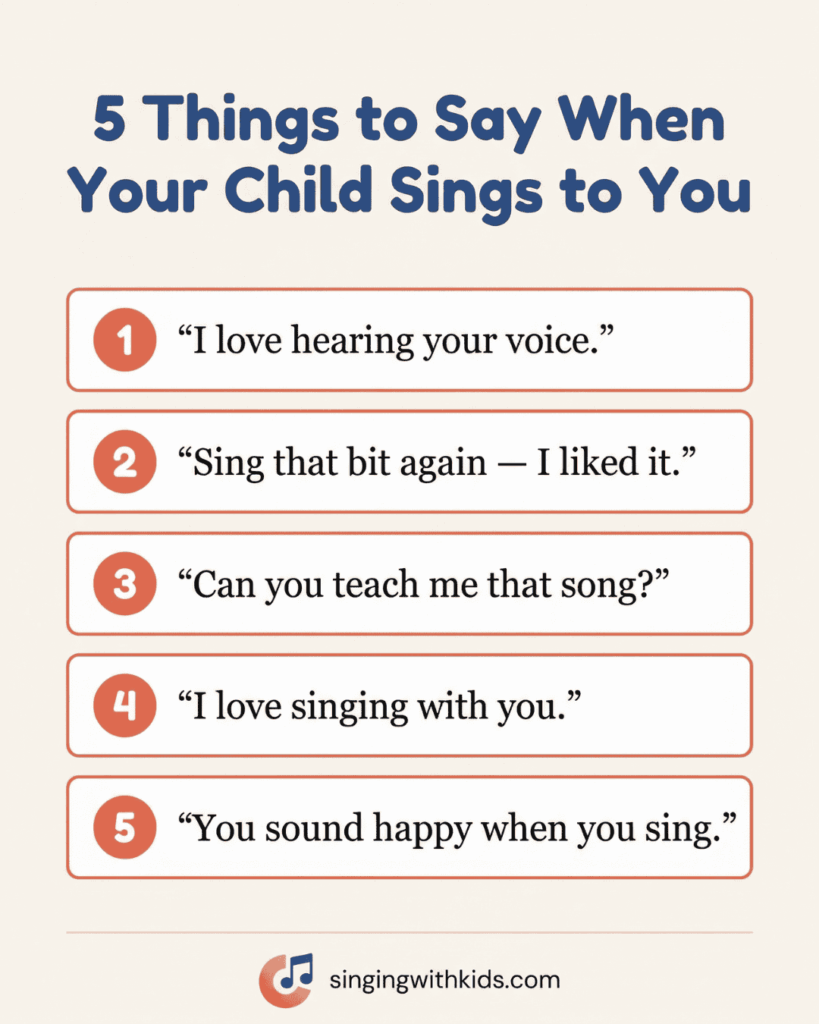
🗣️ Say this instead of “good job”: “I love it when you sing that one. Do it again.” Or just sing along.
Let them move
Young children in particular do not sing well standing still. In my studio, I’ve had students singing from under a table, dancing across the room, spinning in circles. The voice opens up when the body is relaxed and in motion. If your child wriggles and bounces while they sing, that’s not a problem — it’s exactly right.
🗣️ Say this: “Let’s sing it while we dance around the kitchen.” Or don’t say anything — just start moving yourself.
One Thing More Important Than Any of This
After more than a decade teaching children to sing, the most important thing I know about young singers has nothing to do with technique.
Children who are passionate about singing — who want it, ask for it, choose it — develop at a pace that consistently surprises me. I’ve watched children who seemed almost unable to match a simple pitch, who struggled with basic rhythm, who had a very limited natural range, become genuinely accomplished singers. Because they wanted to.
I’ve also seen children with real natural gifts plateau early, or stop altogether. Because it wasn’t their choice. Because someone decided for them that they should.
If your child is asking to sing — make room for it. If they’re not yet, that’s worth paying attention to as well. Keep the music in the background. Sing in your own corner of the kitchen. But a child who goes to lessons only because a parent wants them to is not usually a child building a love of singing. They’re building a complicated relationship with a chore.
The passion is the thing. Everything else can be taught.
Questions Parents Often Ask
Do I need to find a singing teacher straight away?
Not necessarily. For children under 6 or 7, the most important foundation is simply loving music — singing at home, hearing good music regularly, having fun with sound. Formal lessons become much more productive once a child genuinely wants them and is asking for them.
My child’s singing sounds off-key. Is that normal?
Almost certainly, yes. Most children can’t reliably match pitch until around age 5 or 6, and some take until 8 or 9. It’s a skill that develops over time — and the children who develop it fastest are usually the ones who sing the most, not the ones who are most “talented.”
Should I correct my child when they sing the wrong note?
Generally, no — not in the way you might think. Saying “that’s not quite right” without giving them a way to fix it mostly creates anxiety. Instead, sing the note yourself and let them match you naturally. Or just keep singing alongside them. Modelling almost always works better than correcting.
What age should my child start singing lessons?
This depends enormously on the child. Many teachers — including me — prefer to wait until a child is genuinely asking for lessons rather than being steered toward them. Around 6–7 is common, but I’ve had wonderful students who started later. The most important thing isn’t the age. It’s the willingness.
Tonight, while you’re cooking dinner or driving home or getting ready for bed — sing something. Anything. It doesn’t have to be good. It doesn’t even have to be recognizable.
Your child is listening. Not for the pitch. For the permission.