7 Music Activities for Kids at Home That Help Them Sing Better
Table of Contents
7 Music Activities for Kids at Home That Help Them Sing Better
One of my students walked in last year clutching her phone, eyes wide. “I want to learn the Cups song from Pitch Perfect.” She was eight. I could have told her it was too advanced. Instead, we got to work: the rhythm, the cup technique, the melody. A few lessons later, she performed it beautifully.
But here’s what made that possible: her home was full of music. Not lessons. Not formal training. Just music, everywhere, all the time.
The best thing you can do for your child’s singing development isn’t always another lesson. It’s building a musical world at home. And most of it costs nothing, or less than a single class.
Why Home Matters More Than You Think
Music activities for kids at home aren’t just a nice extra. They’re where the real foundation forms. Research into early musical education consistently shows that children who grow up in musically active homes develop stronger listening skills, better pitch awareness, and more natural rhythm, all before any formal training begins.
A five-year USC study found that children who received music training showed faster development of the auditory systems in the brain: the exact systems responsible for pitch discrimination and singing in tune.
I’ll say it plainly: in my experience, you cannot become a great singer without growing as a well-rounded musician at the same time. The voice doesn’t develop in isolation. Everything below will help with that.
1. Start With What You Already Have
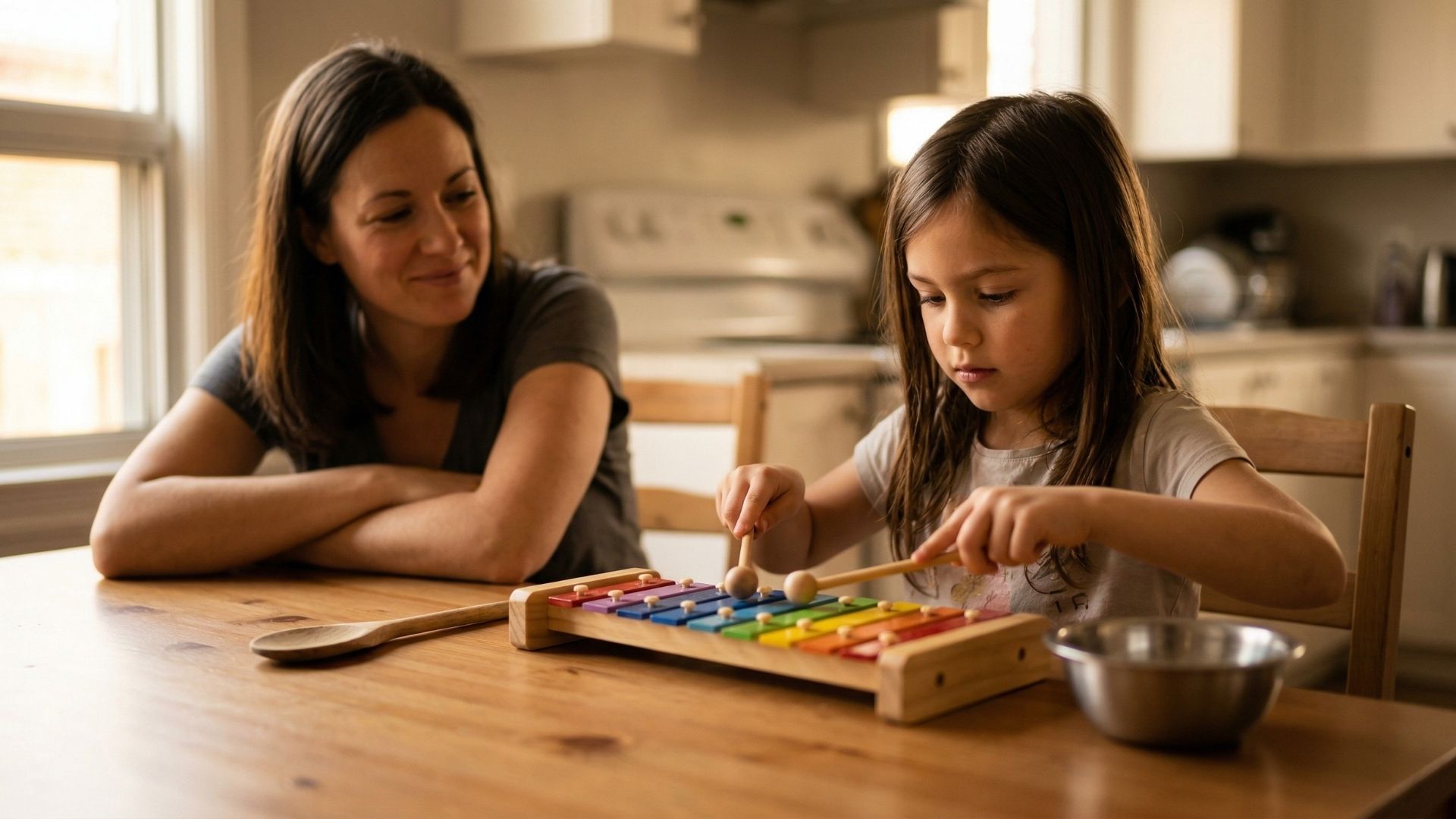
Before you buy anything, open your kitchen cupboards. Pots, pans, wooden spoons, plastic containers, dried rice in a sealed jar. You already have a percussion section. Toddlers especially love this, not because it’s educational (though it is), but because it’s loud and they’re in charge.
Let them bang. Let them experiment with different sounds. Encourage them to try to match a rhythm you tap, or copy a pattern back to you. The goal isn’t noise control. It’s giving them permission to explore sound without fear of doing it wrong.
Research published in Applied Psycholinguistics found that musical activities improve phonological awareness in children as young as three: the same skill that underpins both reading and pitch recognition. The humble kitchen orchestra is doing more than it looks like. For specific kitchen percussion activities, Drake Music has a lovely guide worth bookmarking.
2. Invest in One Good Instrument (Not Twenty Cheap Ones)
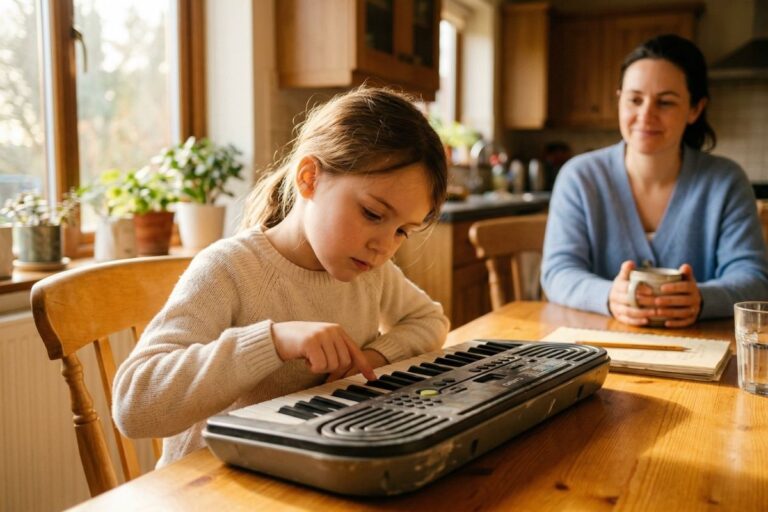
When it comes to instruments for kids, one quality instrument beats a box of plastic toys every time. The ones that tend to make a difference: a proper xylophone, a ukulele, a set of quality hand bells, a Steel Tongue Drum, a recorder, a small keyboard, or a proper shaker set.
Here’s something worth considering: most of these cost the same as one or two private singing lessons. But a good instrument can be played for years, passed between siblings, and picked up every single day. That’s an extraordinary return.
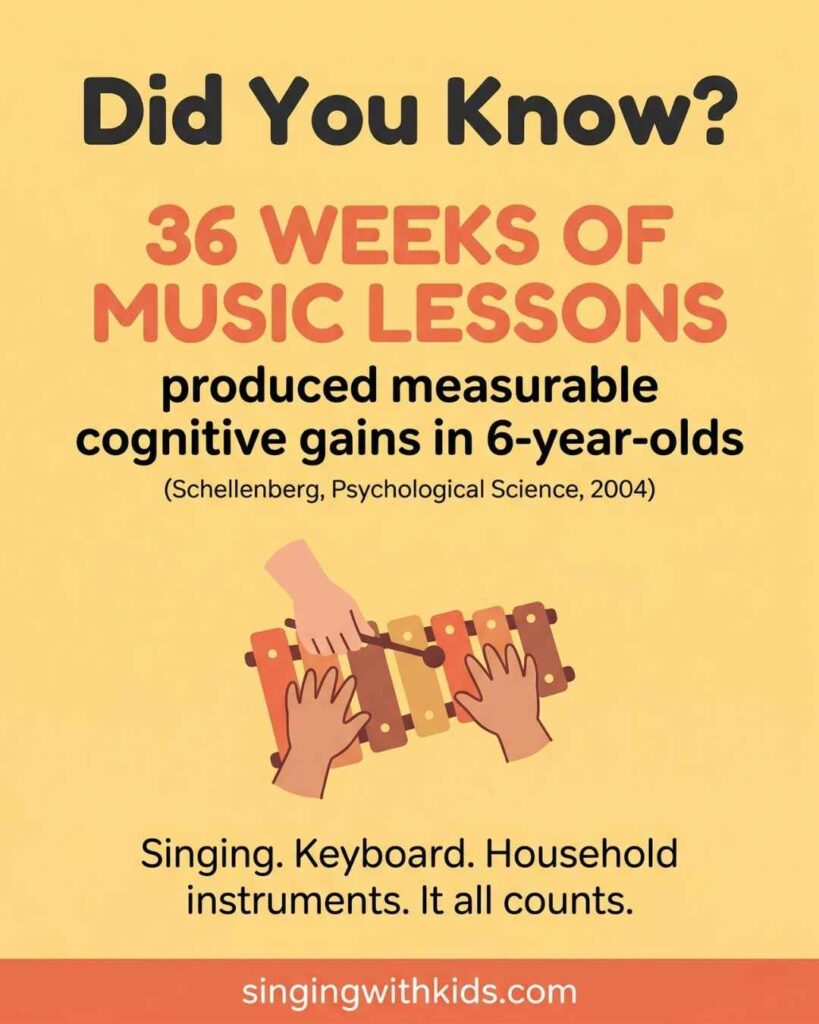
According to Schellenberg’s landmark 2004 study published in Psychological Science, children who received either singing or keyboard instruction for just 36 weeks showed measurably greater cognitive and academic gains than those who didn’t. The instrument matters less than the consistent, joyful engagement with it.
3. Make the Music Shop a Field Trip
This one is underused and completely free. Take your child to a music shop and let them look, touch, and try things. No agenda, no pressure to buy. Just curiosity.
Kids often gravitate toward instruments parents would never have predicted: the child who beelines for the kalimba, the one who can’t stop tapping the Steel Tongue Drum in the corner. That’s genuinely useful information. Curiosity is the best indicator of what they’ll actually practice.
Most music shops are happy to let children try things gently. Call ahead if you’re unsure. When a child chooses their own instrument, they’re far more likely to pick it up tomorrow and the day after.
4. Build a Daily Listening Habit
Active listening is a skill, and it’s one of the most underrated things you can build at home. This doesn’t mean music on in the background all day. That’s passive. It means sitting down together for 10 minutes and really listening to something.
Try this: play a piece of music and ask your child what they notice. Not “do you like it?” That’s too easy. Ask instead: “Can you hear any instruments?” or “Does this music feel happy or sad, and why?” For older children: “Can you hear when the melody repeats?”
Mix it up over time. Classical, jazz, folk, pop, film scores. Variety builds a wider musical vocabulary, which feeds directly into a child’s singing range and expression. You don’t need to know anything about music theory to do this. Engaging with music alongside your child (listening, humming, responding) matters far more than any technical knowledge you do or don’t have.
5. See Live Music Whenever You Can
There is nothing that replaces watching a real musician perform in person. The physicality of it, the energy of the room, the fact that a human being is making that sound right now in front of you. Children feel this in a way that recordings simply cannot replicate.
And you don’t need to spend money. Free live music options are everywhere: outdoor concerts, school performances, community choirs, library music events, buskers. Many professional orchestras run free family concerts and open rehearsal days. A quick search for what’s on in your area will usually turn up more than you expect.
I sometimes organize group visits to live performances as part of my students’ musical education. The effect it has on how they sing afterward is visible. They come back with something different. For younger children especially, early live music experiences leave a lasting impression on how they relate to sound.
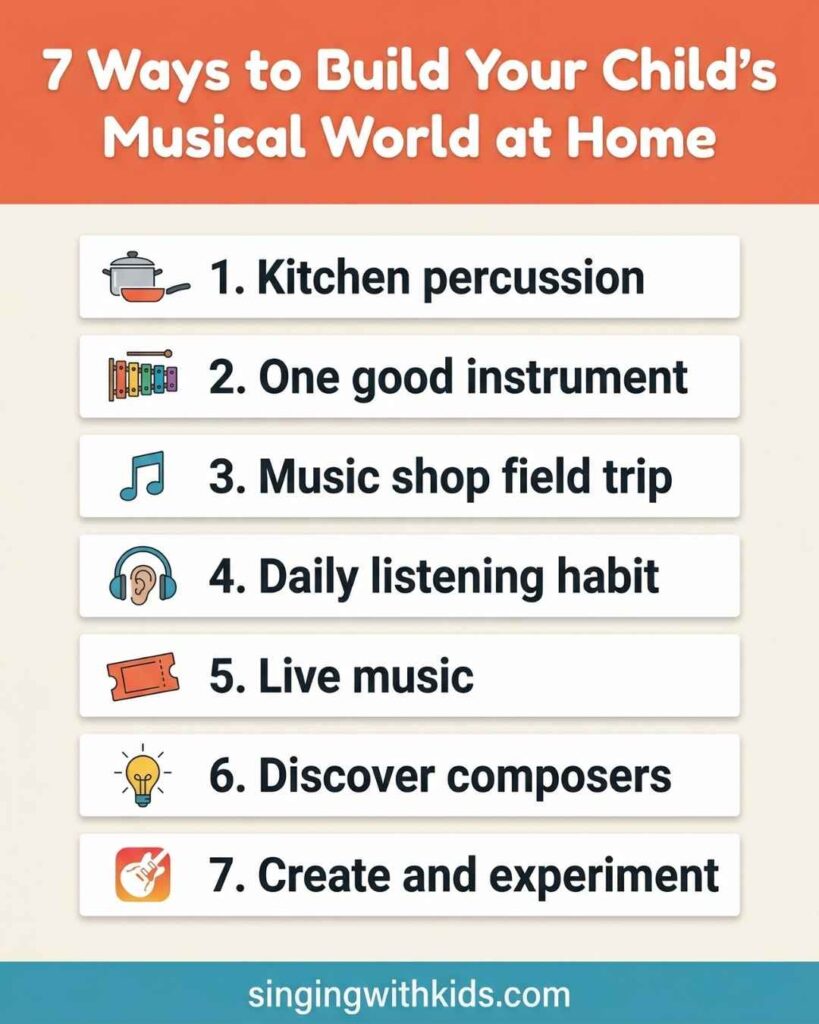
6. Introduce Them to the People Behind the Music
When a child is learning a song in lessons (or just loves a particular piece), I sometimes give them a small piece of homework: find out who wrote it. Then listen to one other thing that same composer or artist made. It might be a completely different style. That’s the point.
A child who sings a lullaby and then discovers that Brahms also wrote a famous symphony has started to understand that music is a living world, not just a playlist. That sense of connection to the wider musical tradition shapes how great singers interpret a song, not just how they execute it.
Keep it simple. A two-minute search, a 60-second clip of a Brahms symphony, a picture of Mozart as a child who performed for kings. Kid-friendly resources are everywhere. Curiosity about the people behind the music is its own kind of ear training.
7. For Older Kids: Experiment, Create, Layer
From around age eight or nine onward, the home musical world can expand into genuinely creative territory. GarageBand on an iPad (free with Apple devices) lets children record their own voice, layer instruments, add effects, and experiment with arrangements. It sounds like play. It is music production.
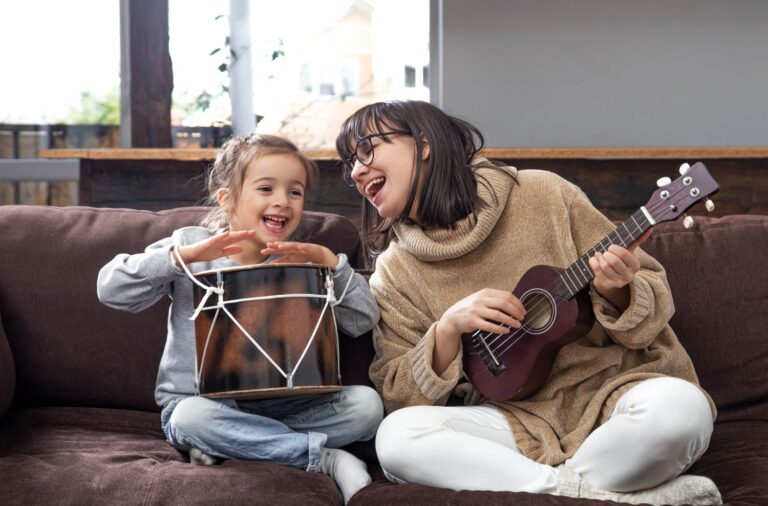
Encourage singing while playing an instrument at the same time. Even simple strumming on a ukulele while humming a melody. Singing with others, harmonizing on the fly, making up songs about whatever happened that day. These activities build the kind of musical flexibility and creative confidence that formal lessons alone rarely develop.
The progression looks something like this: toddlers explore sound freely with whatever they can find. School-age children start connecting what they hear to what they can make. Older kids begin to layer, improvise, and create. Each stage feeds the next. And the research on what singing does for children’s development consistently shows that these varied musical experiences compound over time in ways that are hard to replicate through lessons alone.
Frequently Asked Questions
Do I need to be musical myself to do any of this?
Not at all. Most of these activities work best when you’re genuinely curious alongside your child, not teaching them. You don’t need to know a C major scale to sit and listen to music together, visit a music shop, or let them bang on pots and pans. Your enthusiasm matters far more than your musical knowledge.
What age should children start with instruments at home?
From birth, in some form. Shakers and simple percussion are appropriate for babies and toddlers. A small xylophone or bells works well from around age two or three. More complex instruments like ukulele or recorder become accessible around age five or six, though every child is different. The key at any age is low pressure and high curiosity.
Can too much musical activity at home overwhelm a young child?
Only if it’s forced. Music that a child chooses, initiates, or explores alongside a playful parent doesn’t overwhelm. It energizes. What to watch for is the opposite: a child who goes quiet when music comes on, or who starts treating it like a chore. That’s a signal to step back and make it smaller and more joyful again.
How does playing instruments at home connect to singing specifically?
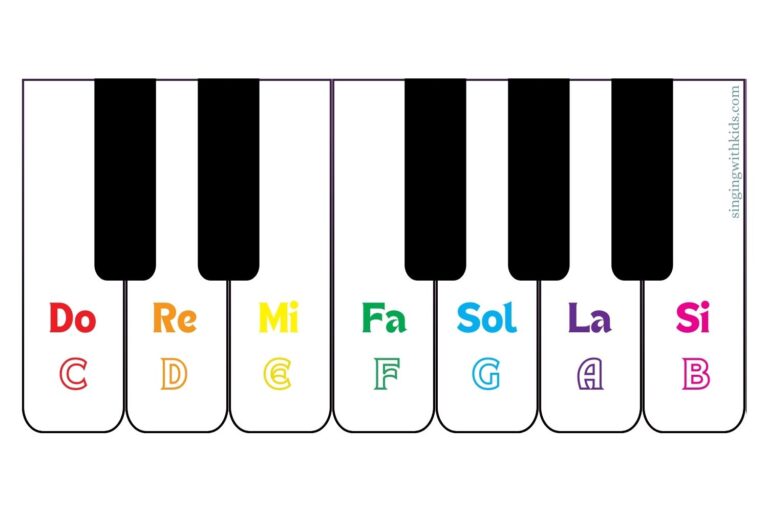
More directly than most people realize. Experimenting with pitch on a xylophone or keyboard trains the ear to recognize intervals: the same skill a singer uses to stay in tune. Rhythm games build the internal timing that makes phrasing feel natural. A child who grows up playing with sound in any form is already working on their voice, even when they’re not singing.
Five Minutes Is Enough to Start
You don’t need a music degree. You don’t need an expensive setup. You don’t need to be able to carry a tune yourself.
What you need is already in your kitchen cupboards, your phone’s music library, and your town’s events calendar. Five minutes of active listening together is worth more than a week of music playing in the background. One instrument played with genuine joy beats a room full of plastic toys.
Your micro-challenge for today: Put on one piece of music (something you genuinely love, not something you think your child should like) and sit with them for three minutes. Just listen together. See what they notice. That’s the start of everything.