Is My Child Tone Deaf? What Singing Teachers Know That Most Parents Don’t
One of the most common things parents say when they first bring a child to my studio is some version of this: “I just wanted to warn you — she can’t really carry a tune.” They say it quietly, like an apology. Like they’ve already decided something is permanently wrong.
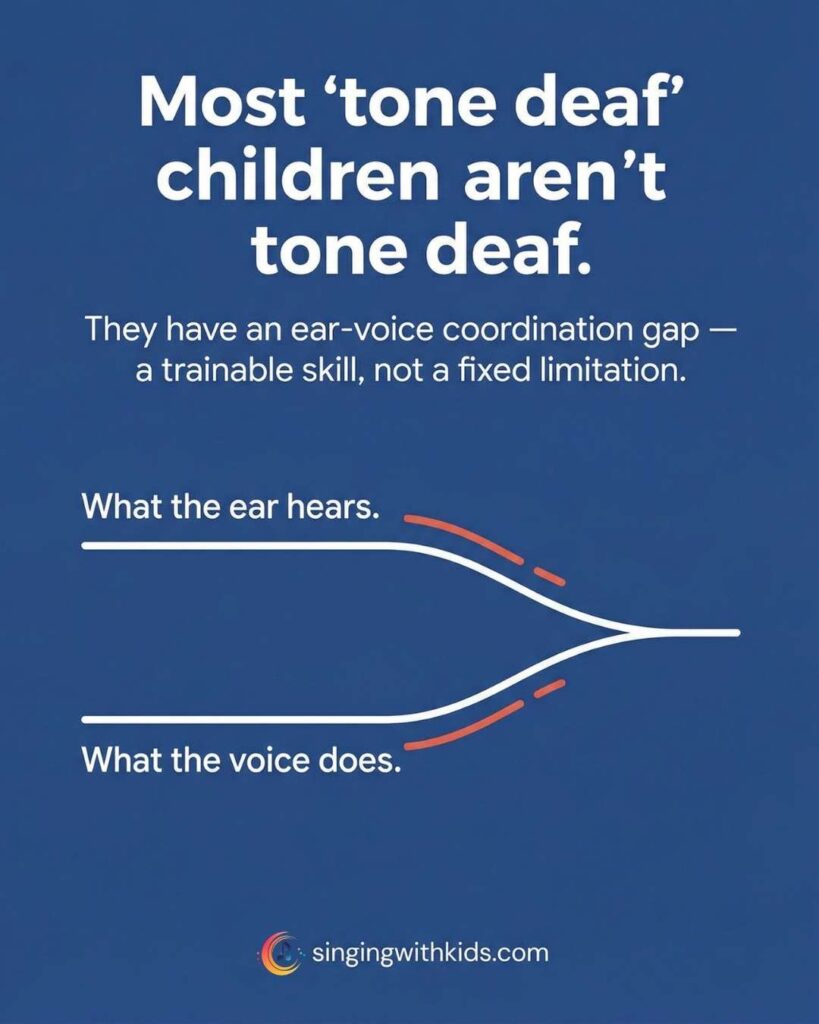
Nearly every child labelled “tone deaf” can learn to sing in tune. What parents are almost always seeing isn’t a fixed limitation — it’s an untrained skill. A coordination between ear and voice that simply hasn’t been practiced yet. Understanding that difference changes everything about how you respond to it.
Table of Contents
What “Tone Deaf” Actually Means (And What It Usually Isn’t)
True tone-deafness (the inability to perceive pitch differences even when just listening) does exist. It’s called congenital amusia, and it affects roughly 4% of the general population. It’s real. It’s also rare. And if your child sings enthusiastically, hums along to songs they love, or reacts differently to fast music versus slow music, they almost certainly don’t have it.
What most children labelled tone deaf are actually experiencing is something different: a disconnect between what their ear hears and what their voice produces. The brain receives the pitch. The voice doesn’t land there.
Think of it like handwriting. A child who writes messily isn’t blind, they can see perfectly well. The problem is in the coordination between what they see and what their hand does. With patient, consistent practice, the gap closes. Singing pitch works the same way.
There’s a third possibility too, and it’s the most overlooked: some children who seem “off pitch” aren’t struggling to hear the melody at all. They’re singing it in the only range their untrained voice currently reaches, a third lower, say, or in chest voice when the song needs head voice. Every note they produce is accurate for where their voice is. The melody is just out of reach for now. That’s a completely different issue from tone deafness, and it has completely different solutions.
The One Question Worth Asking Before You Worry
Before anything else: how old is your child?
Children’s pitch accuracy develops most rapidly between ages five and eight, and many children sing reliably in tune by six or seven. But plenty of perfectly typical children take until nine or ten. If your child is under six and sings off-pitch, this may not be a problem at all. It may simply be Tuesday.
There’s also one thing worth ruling out early, particularly if your child has had recurring ear infections: get their hearing checked. Mild conductive hearing loss (common in young children and often temporary) can make it genuinely difficult to hear pitch differences clearly. If a pediatrician or audiologist gives them the all-clear and they’re still struggling, then we’re in the territory this article is about.
One Student I’ll Never Forget
She came to me at eight years old. Couldn’t reliably match pitch, had trouble with rhythm, and had a limited range even for simple songs. She was also extremely shy, the kind of child who barely made eye contact in the first lesson.
I started her on songs that were, honestly, a bit young for her. Simple melodies, short phrases, very basic rhythm. Her mum was quietly skeptical. About a month in, she pulled me aside: “I’m just wondering if we made the right choice.”
I explained why I’d chosen those songs. I needed to give her daughter something she could actually handle at her current level, something she could succeed at and build from, rather than a song beyond her reach that would set her up to feel like she was failing. I asked them to trust the strategy.
They did. And I’m so glad they did.
Four years later, that girl stood on stage singing jazz — jazz, with a live accompanist playing complex harmonies underneath her — and she nailed it. The shy eight-year-old who struggled to match a simple melody was gone. In her place was a confident young singer who knew, bone-deep, that consistent effort pays off.
She wasn’t my only student like this. A nine-year-old boy came to me with almost identical struggles: limited range, pitch matching was hit-or-miss, couldn’t always hear the gap between what the song needed and what his voice was doing. Two years later his range had more than tripled, pitch was no longer an issue, and his voice had developed a warmth and power that genuinely surprised people who’d heard him before. He went on to enter vocal competitions. His voice only got stronger after it changed with puberty.
These aren’t exceptional stories. They are what happens when a child who wants to sing is given time and the right approach.
Why Passion Matters More Than Starting Point
I want to say something that some singing teachers won’t: I love working with children who struggle with pitch. When a naturally gifted singer walks into my studio, there’s real pleasure in working on advanced technique and expanding their repertoire. But when a child comes in with pitch challenges and a fire in them to sing — that’s where I get to put everything I know to work.
Some teachers will only take students they can showcase quickly. I understand the reasoning. But I think those teachers miss something important: the child with the natural gift sometimes hits a wall later, when talent alone isn’t enough and the habit of working hard was never built. The child who had to work for every improvement often becomes the more resilient, more dedicated musician in the long run. They’ve learned something the other child hasn’t — that effort changes things.
If your child has a passion for singing and the willingness to keep going, that is the most important thing in the room. More important than their starting pitch. More important than your musical background. More important than how they sounded in last year’s school concert.
What You Can Actually Do at Home
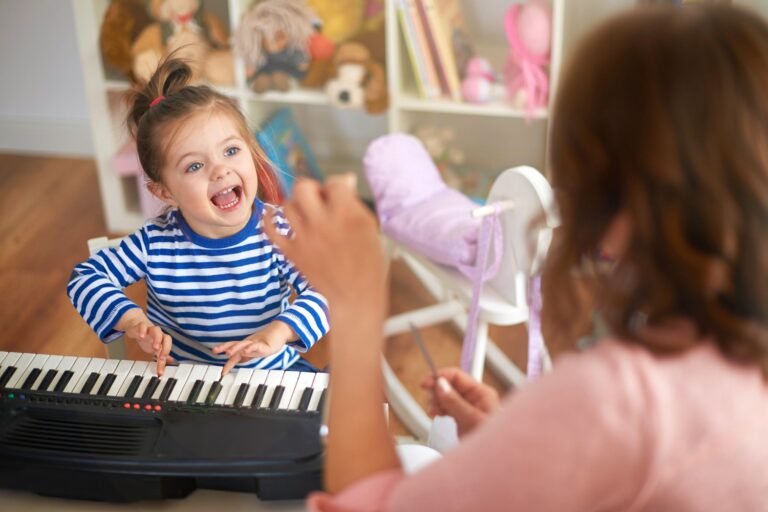
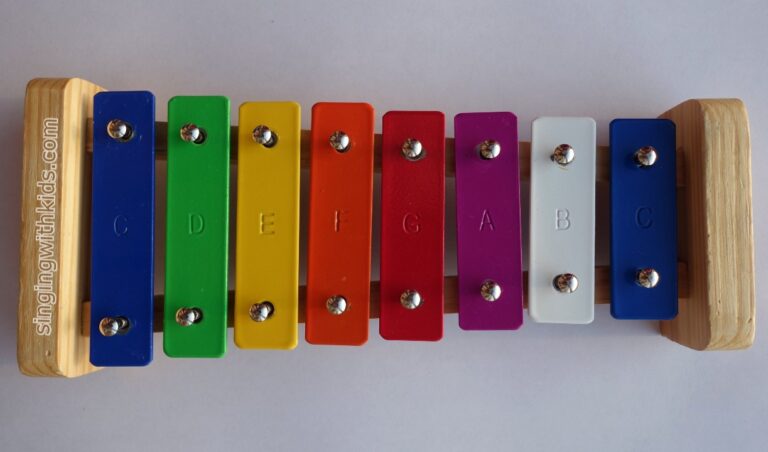
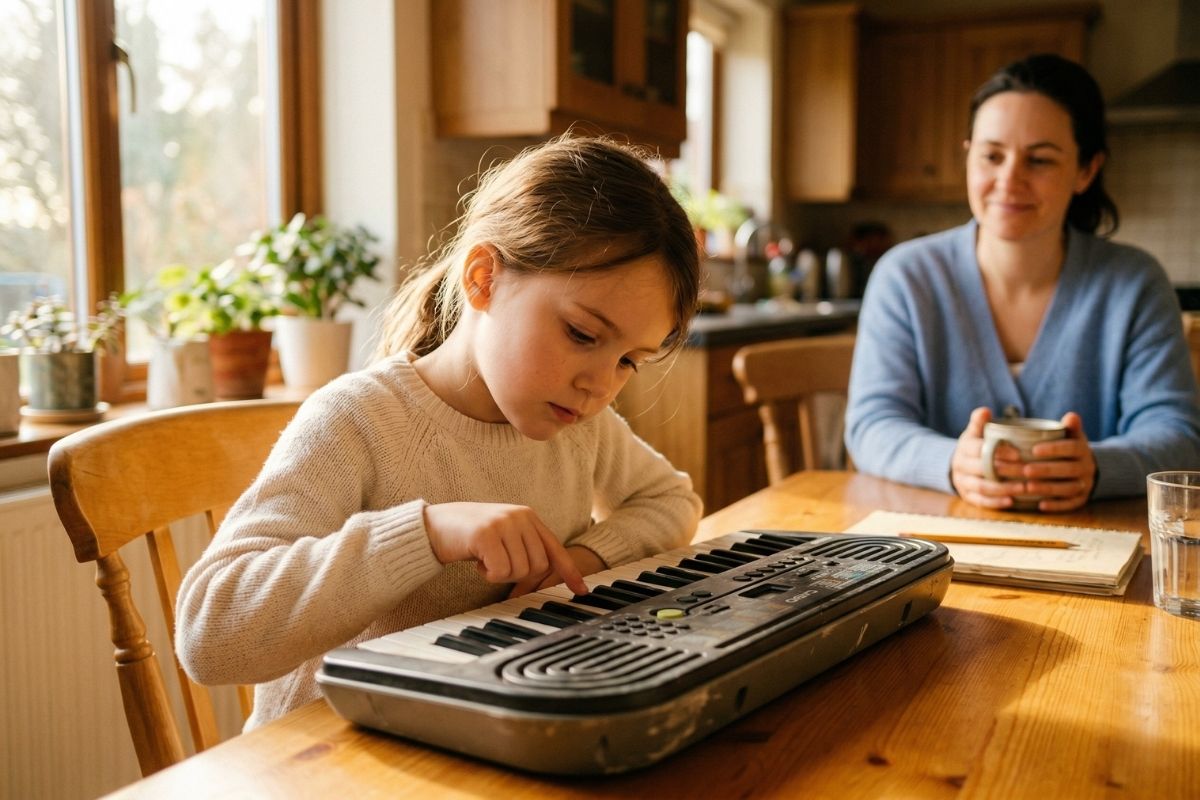
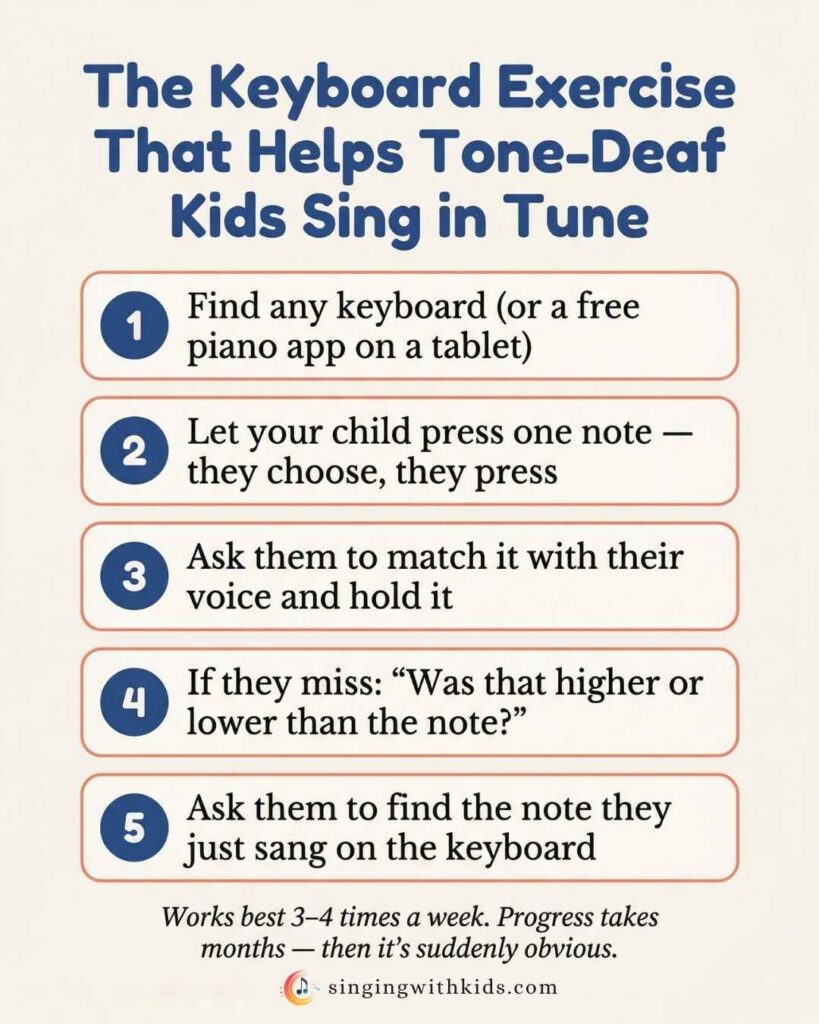
You don’t need to be a musician to help. You need a small keyboard, or even a free piano app on a tablet.
Have your child press a single key on the keyboard themselves — not you, them — and then try to match that note with their voice. Sustain it. Listen to it. Try to find it.
The reason the child presses the key is not incidental. When they control the sound, the connection between what they hear and what they try to do with their voice is tighter. Their brain is more engaged. In my experience, this works noticeably better than a parent or teacher pressing the key and asking them to match it. The act of choosing and pressing the note is part of the learning.
When they get it wrong, and at first they will, don’t correct it immediately. Ask:
🗣️ Say this: “Do you think you sang that higher or lower than the note?”
Then: “Can you find the note you just sang on the keyboard?”
Have them press keys until they find the sound they accidentally made. This is where real ear training begins: not correcting pitch, but learning to hear the difference. Noticing. Comparing. The ear learns to listen more carefully when it’s hunting for something.
Even fifteen minutes a few times a week, practiced consistently over months, produces real change. It’s not dramatic or immediately obvious — and then one day it suddenly is.
One thing I’d add: pitch apps can be a useful occasional check, but don’t let them become the main event. The goal is to train the ear to listen and self-correct without technology. Use an app now and then to see where things are. Build the skill without it.
When “Slightly Off” Is a Different Problem Entirely
If your child sings fairly well but consistently lands just below or above the note (not wildly off, but a consistent small gap), this often isn’t an ear-voice coordination issue at all.
It might be breath support. A voice without enough diaphragmatic support tends to drift flat, especially at the ends of phrases. It might be vocal placement: the position of the voice in the body can pull pitch down or push it up. These are foundational technique issues, and they often resolve dramatically once a child learns proper breathing and vocal support. This is the kind of thing that’s hard to fix at home without guidance, because the causes vary between individuals.
A good singing teacher can hear what’s actually happening and find the right lever. Sometimes one or two adjustments change everything.
What Your Child Needs to Hear From You
How you respond when your child sings off-pitch shapes how they feel about singing for years. A few things worth knowing:
Never correct the pitch in the moment of performance. If your child is singing a song for you (really singing, not practicing), this is not the time. Let them finish. Celebrate that they sang. Pitch can be worked on another time.
When you are practicing together, questions work better than corrections. “Do you think that was the same note?” invites reflection. “That was wrong” just produces shame.
🗣️ If they ask whether they’re a good singer: “Your voice is getting stronger every time you sing.” Because it is. Even if it doesn’t sound like it yet.
Frequently Asked Questions
Is it normal for young children to sing off-pitch?
Completely normal, especially under age six or seven. Pitch accuracy in children develops gradually throughout the early school years, and many children who seem off-pitch at five are singing reliably in tune by eight or nine with regular exposure to music and singing.
Can a child learn to sing in tune if they truly can’t match pitch right now?
In almost every case, yes. True congenital tone-deafness (amusia) is rare (around 4% of the population) and even children with genuine pitch perception difficulties often improve significantly with early musical training. What most parents are seeing is a coordination skill that simply needs practice.
At what age should I start worrying about pitch problems?
If your child is under six, I’d encourage you not to worry at all. If they’re seven or older, consistently off-pitch, and it’s not improving over time, a conversation with a singing teacher, or a hearing check with your pediatrician, is a reasonable next step. Not because something is wrong, but because getting the right information early makes everything easier.
My child gets embarrassed when I try to help. What should I do?
Step back from direct correction and go indirect. The keyboard game works well partly because the child is interacting with the keyboard, not with a parent waiting to hear if they got it right. Less pressure, more play. The improvement still happens.
Imagine standing over a baby taking their first wobbling steps: falling, getting up, falling again. Nobody looks at that baby and says, “She just doesn’t have natural talent for walking. Let’s not encourage her.”
We know, instinctively, that walking is something every child will learn. We give them the floor, the time, and someone to hold their hand.
Singing is the same. It just takes longer than the world has been patient enough to notice.
Tonight: pull up a piano app on your phone or tablet. Hand it to your child. Ask them to press one note and see if they can find it with their voice. Don’t correct. Don’t coach. Just listen to what they do.
That’s where it starts.